
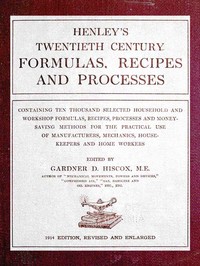
Henley's Twentieth Century Formulas, Recipes and Processes by Gardner Dexter Hiscox
Forget about a traditional story with characters and a plot. Henley's Twentieth Century Formulas is a different beast entirely. Think of it as the ultimate pre-internet hack manual, published in 1914. The 'plot' is humanity's drive to create, fix, and sometimes concoct things we probably shouldn't. The book is a giant catalog of over 10,000 entries, each a recipe or process for solving a practical problem. One page walks you through making varnish for paintings; the next explains a method for refining petroleum or creating a fireproof coating for theater scenery. It jumps from the mundane (shoe polish) to the industrial (tanning leather) to the downright alarming (various chemical explosives and potent medicines). There's no narrative thread, just an endless, fascinating stream of early 20th-century knowledge, both brilliant and perilous.
Why You Should Read It
You should read this not for practical use—please, do not try these at home—but for the unique window it provides. It’s a snapshot of a world where chemistry was a exciting new frontier for the everyday tinkerer. The tone is wildly confident and accessible, making complex industrial processes sound like weekend projects. This gives you a real sense of the DIY spirit of the era. I found myself completely absorbed by the odd details and the now-obsolete problems it solves. It’s also quietly hilarious in its bluntness; the book treats making nitro-glycerin with the same straightforward tone as making laundry starch. It’s a reminder of how much we’ve learned about safety, and how the thirst for practical knowledge hasn't changed, even if our methods have.
Final Verdict
This book is a niche treasure. It’s perfect for history buffs, fans of vintage how-to manuals, steampunk enthusiasts, or anyone who loves seeing the gritty, practical side of a bygone era. If you enjoy browsing old scientific journals or catalogs, you'll get lost in this. It’s not a cover-to-cover read, but a fantastic book to dip into for a glimpse of the inventive, chaotic, and wonderfully optimistic mind of the early 1900s. Just maybe keep a fire extinguisher nearby for the vibes.
This book is widely considered to be in the public domain. Feel free to use it for personal or commercial purposes.
Anthony Clark
2 years agoAfter hearing about this author multiple times, the depth of research presented here is truly commendable. A true masterpiece.





David Lee
1 year agoThe formatting on this digital edition is flawless.