
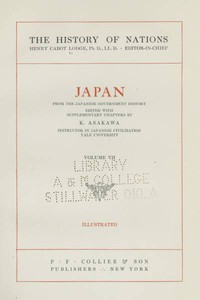
Japan: From the Japanese Government History by Kan'ichi Asakawa
This book is a unique artifact. It’s not a narrative written by a single historian, but a translation of the official history sanctioned by the Japanese government in the early 20th century. Scholar Kan'ichi Asakawa brought it to an English-speaking audience. The ‘story’ it tells is the grand sweep of Japan’s past, from its mythical origins to the modernizing Meiji era, all presented as a smooth, purposeful march toward national unity and imperial strength.
The Story
Think of it less as a story with characters and more as an epic, state-approved biography of a nation. It starts with ancient myths about divine emperors, moves through the classical and feudal periods, and culminates in the restoration of the Emperor’s power and Japan’s rapid modernization. The ‘plot’ is Japan’s destiny to become a unified, sovereign, and respected world power. Conflicts are framed as necessary steps on this path, and the focus is almost always on institutions, rulers, and national progress, not on the everyday lives of ordinary people.
Why You Should Read It
You don’t read this book to get the full, unbiased truth of Japanese history. You read it to understand how a powerful government wanted the world to see it at a critical moment in its rise. It’s a primary source about nationalism itself. The gaps are as telling as the content. The smooth narrative brushes past internal strife and the harsh realities of feudalism. Reading it feels like being shown the official portrait, not the candid behind-the-scenes photos. That makes it incredibly valuable. It challenges you to be an active reader, to question every claim, and to wonder about the silences. It turns history from a passive subject into an interactive detective game.
Final Verdict
This is a must-read for anyone seriously interested in Japanese history or the mechanics of nationalism, but it’s not a beginner’s guide. It’s perfect for history buffs who already have a basic timeline and want to analyze how history gets made and marketed. Pair it with a modern, critical history of Japan—reading them together is where the real magic happens. It’s a dry, formal text by design, but if you approach it as the fascinating political document it is, you’ll find it utterly absorbing.
This publication is available for unrestricted use. Feel free to use it for personal or commercial purposes.
Kimberly Clark
4 months agoFinally a version with clear text and no errors.
Andrew Lee
7 months agoBeautifully written.
William Jones
11 months agoVery interesting perspective.
Daniel Sanchez
9 months agoSimply put, the depth of research presented here is truly commendable. Absolutely essential reading.







Donna Thompson
1 year agoI was skeptical at first, but the atmosphere created is totally immersive. Exceeded all my expectations.