1

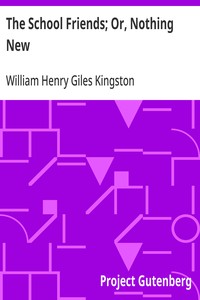
The School Friends; Or, Nothing New — Reading Companion
(0 User reviews)
1515
Project Gutenberg
2012
Not confirmed
Conduct of life -- Juvenile fiction; Islands -- Juvenile fiction; Friendship -- Juvenile fiction; Brothers -- Juvenile fiction; Voyages and travels -- Juvenile fiction; Seafaring life -- Juvenile fiction; Shipwrecks -- Juvenile fiction; Students -- Juvenile fiction; Youth -- Conduct of life -- Juvenile fiction; Missionaries -- Juvenile fiction
Readers of public-domain and historical texts
Project Gutenberg digital edition
en
Edition facts
Words
55,894
Reading time
244 min
Text sections
7
The source record for The School Friends; Or, Nothing New — Reading Companion measures this digital text at 55,894 words, 4 hr 4 min estimated reading time, and 7 detected text sections.
The text analysis averages about 21.6 words per sentence, while the detected sections provide another way to judge how the source is divided.
Project Gutenberg metadata also associates the work with “Conduct of life -- Juvenile fiction,” connecting these edition facts with the source record’s subject description.
Source:
Project Gutenberg record #40688
This editorial note examines how the opening, middle, and later excerpts of Kingston's 1860s boys' adventure shape a first reading, focusing on the contrast between schoolroom moralizing and the smuggler encounter's visceral danger.
Read the complete public-domain text at its original source.
Read on Project GutenbergThe first chapter introduces Lance Loughton and Emery Dulman at Elmerston Grammar-School, establishing a familiar pattern of contrasted schoolboys: Lance is "steady, persevering, and studious," while Emery is "good-natured and full of life and spirits" but easily led. The narrator explicitly states that without "interchange of thought" real friendship cannot exist, signaling a didactic intent. Yet the opening also hints at social tensions—Emery's father is a tradesman who apes gentility, while Lance's widowed mother is "a lady by birth and education." This class dynamic, rather than the moral contrast, may prove more telling as the story unfolds.
From Schoolroom to Smuggler's Coast
The excerpts jump from school life to a nocturnal encounter with smugglers, where young Gilbert Maitland is captured. The shift is abrupt: the earlier moral framework of Lance and Emery gives way to a world of armed men, oaths, and threats of hanging. Gilbert's terror is rendered in concrete detail—"he felt ready to drop from his pony with terror"—and the smugglers speak in a rough, colloquial register that contrasts with the school chapters' measured prose. The reader must decide whether the school scenes are a prelude or a separate story; the title "The School Friends; Or, Nothing New" and the catalog listing seven text sections suggest multiple narratives may be linked.
The Smugglers' Code and Gilbert's Peril
Gilbert's captors operate with a clear internal logic: they suspect him of spying because his father "brought the soldiers down upon us." The smuggler captain's threat—"The easiest way would be to leave him here to frighten the crows"—is chillingly casual. Yet the narrative also shows the smugglers' professionalism: they have misled the military and plan to disperse goods across the country. Kingston does not simply demonize them; they are competent and organized. Gilbert's plea for mercy is met with skepticism, and the excerpt ends with him being led away, his fate unresolved. This ambiguity, rare in didactic fiction, may signal that the story will complicate simple moral judgments.
Voice and Structure Across Excerpts
The excerpts reveal two distinct narrative voices. The school chapters employ a third-person omniscient narrator who comments directly on character and morality: "Without it real friendship can scarcely be said to exist." The smuggler chapters, by contrast, are more dramatic, with dialogue driving the action and the narrator staying largely invisible. This structural shift—from moral exposition to suspenseful scene—may reflect Kingston's attempt to balance instruction with entertainment. The catalog subjects include "Conduct of life" and "Seafaring life," suggesting the book moves between these poles. First-time readers should note how the narrator's presence fades when danger rises.
Recurring Details and Their Implications
Several details recur across the excerpts: the importance of a father's reputation (Lance's naval lieutenant father, Gilbert's father who opposed smugglers), the threat of violence (bullying at school, pistols and hanging on the road), and the theme of being "led" astray (Emery is "easily led," Gilbert is led away by captors). The word "nothing" in the title may hint at a cyclical pattern—perhaps the school friends' moral choices echo in later adventures. The excerpts do not resolve this, but attentive readers can watch for how characters' pasts shape their responses to crisis.
Because the excerpts cover only the opening and a later episode, the overall plot remains unclear. Readers should approach the text as a series of linked moral vignettes rather than a single continuous narrative. Pay attention to shifts in tone and narrative distance; they may signal Kingston's varying aims—to instruct, to thrill, or to explore the gap between stated principles and lived experience. The smugglers' scene, in particular, rewards close reading for its tension between sympathy and condemnation.
There’s a particular ache in rereading old boys’ adventures, isn’t there? The schoolroom sermons fade, but the smuggler’s lantern glow stays stubbornly bright. I found that same strange honesty again in the quieter, salt-stained moments of Rick Dale, A Story of the Northwest Coast — Text and Context — where the real danger isn’t moralizing, just the cold, indifferent sea.
There are no reviews for this eBook.
There are no comments for this eBook.
Reader reflection
How did this book work for you?
Your answers remain private and are stored only in this browser.
Your progress
0
/
10
2
How much did you enjoy the reading experience?
3
Would you recommend this book to another reader?
4
How much effort did this book require?
5
How personally connected did you feel to the book?
6
How well did it match your expectations?
7
Could you apply anything you learned?
8
Do you expect to return to this book?
9
In one sentence, what did you learn?
10