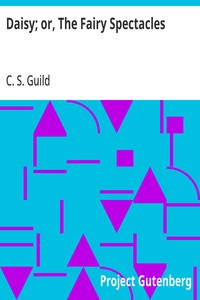
Daisy; or, The Fairy Spectacles — Key Ideas to Explore

(2 User reviews)   624
Guild, C. S. (Caroline Snowden), 1827-1898 Project Gutenberg 2011 Not confirmed
Christian life -- Juvenile fiction; Conduct of life -- Juvenile fiction; Children -- Conduct of life -- Juvenile fiction; Fairies -- Juvenile fiction; Allegories; Kindness -- Juvenile fiction; Children and death -- Juvenile fiction; Wisdom -- Juvenile fiction Readers of public-domain and historical texts
Project Gutenberg digital edition en

Edition facts

Words 29,111
Reading time 127 min
Text sections 4

The source record for Daisy; or, The Fairy Spectacles — Key Ideas to Explore measures this digital text at 29,111 words, 2 hr 7 min estimated reading time, and 4 detected text sections.

The text analysis averages about 26.4 words per sentence, while the detected sections provide another way to judge how the source is divided.

Project Gutenberg metadata also associates the work with “Christian life -- Juvenile fiction,” connecting these edition facts with the source record’s subject description.

An editorial note on the structure and imagery of C. S. Guild's 1857 allegory, focusing on the movement between forest isolation and visionary scenes, the recurring motif of spectacles, and the use of contrasting domestic and supernatural settings.
Share
Editorial Edition Score 4.6/5

Calculated from edition completeness, EPUB availability, text structure and catalogue metadata. Not a user rating.

How this score is calculated
  • Description quality20 pts
  • Title & short description10 pts
  • Source metadata20 pts
  • Text length15 pts
  • Chapters / structure15 pts
  • EPUB file integrity20 pts

Total of 100 points, scaled to a 2.5-5.0 range. Editions with an empty description or a missing EPUB file are not scored.

Edition quality

Read the Text

There was a great forest, once, where you might walk for miles, and never hear a sound except the tapping of woodpeckers, the hooting of owls, or the low bark of wolves, or the strokes of a woodman's axe.

For on the borders of this wild, solitary place one man had built his little house, and lived there. It was very near the trees which he spent his time in cutting down; and Peter thought this all he cared about.

But when the summer wore away, and the cold, lonely winter months came on, and there was no one to keep his fire burning and the wind from sweeping through his home, and no one to smile upon him and comfort him when he came back tired from his hard day's work, Peter grew lonely, and thought he must find a wife.

So he went to a market town, a whole day's journey off; for he knew it was a fair-day, and that all the young women of his acquaintance would be there, and many more beside.

At first he looked about for the most beautiful, and asked her if she would be his wife; but the beauty tossed her head, and answered, not unless he lived in a two-story house, and had carpets on his floors, and a wagon in which she could drive to town when she chose.

All this, was very unlike the home of poor Peter, who had nothing in the world but his rough little cabin and a barrow in which he wheeled his wood.

The next maiden told him he had an ugly scar on his face, and was not good looking enough for her; and, besides, his clothes were coarse. The next declared that she was afraid of wolves, and would rather marry one of the village youths, and live where she could hear the news, and on fair-days watch the people come and go.

So Peter started for his lonely home again, with a sadder heart than he left it; for there was no chance that he could ever grow handsome or rich, and therefore he thought he must always dwell alone; instead of the music of kind voices, with which he had hoped to make his evenings pleasant, he was still to hear only the cracking of boughs, and hissing of snakes, and the barking of wolves.

But suddenly he met in the road some people who seemed more wretched than himself--an old, bent woman, clad in rags, and with such an ugly face that, strong man as he was, Peter could not look at her without trembling, and a girl whom she led, or rather dragged along, through the dusty road.

The girl looked as if she had been weeping and was very tired; she did not raise her swollen eyes from the ground while Peter talked with her companion. The old dame said she was a silly thing, crying her eyes out because her mother was dead, when she ought to be thankful to be rid of one so old, and sick, and troublesome.

The girl began to cry again, and the woman to scold her loudly. "Just so ungrateful people are," she said; "when I have promised to find a place where you can live at service, and earn money to buy a new gown, you must needs whimper about the old body that's well enough in her grave."

"Perhaps the poor child is lonely," said Peter, who had a kind heart under his rough coat, and knew, besides, from his own experience, what a hard thing it is to live with no one to love us and be grateful for our care.

The girl looked up at Peter with her pale, sad face; but her lips trembled so that she could not thank him. And he began to think how this poor beggar must have a gentle and loving heart, because she had taken such good care of her old mother, and, notwithstanding she was so troublesome, had been grieved at losing her.

So he made bold to ask once more what he had been refused so many times that day, and had never thought to ask again, whether she would marry him, and live in his little cabin, and cook his meals, and keep his fires burning, and smile and comfort him when he should come home tired from his work.

And at these words a bright smile came into the face of the old woman, and seemed for an instant to take its ugliness away. She put the girl's hand into his, and said to her, "One who can forget his own trouble in comforting another will make you a good husband, Susan."

The story opens in a great forest where the only sounds are woodpeckers, owls, wolves, and a woodman's axe. This initial setting establishes a world of isolation and labor, with Peter the woodman living alone until he seeks a wife. The narrative quickly introduces a pattern of movement between the cramped cabin and expansive, dreamlike visions—a structural rhythm that persists throughout the excerpts. Daisy's fairy spectacles become the device that bridges these realms, allowing her to see beyond immediate danger into allegorical scenes of angelic protection and divine watchfulness.

Forest and Cabin as Recurring Settings

The forest and the woodman's cabin are not merely backdrops but active elements in the story's structure. The opening chapter emphasizes the forest's solitude: "you might walk for miles, and never hear a sound except the tapping of woodpeckers." This isolation is contrasted with the cabin, a fragile shelter that during a storm "rocked in the wind like a cradle." The cabin becomes a site of vulnerability, where Maud fears wolves will "break through the slender door." The narrative repeatedly returns to this domestic space, using it as a staging ground for Daisy's visionary experiences. The movement from cabin to vision and back again creates a clear structural pattern: danger or conflict in the cabin prompts Daisy to use the spectacles, which transport her (and the reader) to a different, often allegorical scene. This oscillation between cramped reality and expansive vision defines the story's pacing.

The Spectacles as a Structural Device

The fairy spectacles function as a narrative hinge, allowing the story to shift between literal and figurative registers. When Daisy falls asleep with them on, she sees "the night, and the storm, and our cabin, and myself asleep—all as if in a picture." This framing turns the immediate crisis into a tableau, observed from a detached perspective. The spectacles also enable Daisy to perceive an angel "bending over me, and shading my eyes from the dazzle with her own white wings." This vision is not merely decorative; it advances the plot by calming Maud's fears and prompting Daisy to act. The spectacles thus serve as a structural tool for introducing moral and spiritual lessons without abandoning the narrative momentum. Their presence is consistent: from the chapter title "The Spectacles" onward, they are the primary means by which Daisy accesses the story's allegorical dimension.

Contrasting Visions: The City and the Cabin

One of the most striking structural contrasts occurs when Daisy, in the midst of a storm, describes a vision of a "strong city, with walls, and towers on the walls, and with watchmen walking to and fro." This urban scene is juxtaposed with the vulnerable cabin in the forest. Inside the city, Daisy sees a rich girl asleep, threatened by thieves who "snatched the jewels" and ultimately kill her. The angel's whispered lesson—"there is only one hand that can save; there is one eye that watches, over rich and poor, the crowded city and the lonely wood, alike"—explicitly links the two settings. The narrative uses this parallel to reinforce a theme of divine protection that transcends physical location. The city vision is not a escape from the cabin's danger but a mirror that reframes it, suggesting that safety depends on spiritual rather than material circumstances.

Movement Between Dialogue and Description

The excerpts reveal a pattern of alternating between extended descriptive passages and rapid, tense dialogue. The storm scene, for instance, shifts from Maud's angry commands—"Come, selfish girl," "look through your old glasses"—to Daisy's calm, detailed account of her vision. This alternation creates a rhythm of conflict and resolution. Maud's interruptions ("Was she handsomer than I?") ground the supernatural in sibling rivalry, while Daisy's descriptions ("the carpet was soft as moss, and the muslin curtains hung like clouds") provide sensory detail. The dialogue often serves to advance the plot: Maud's skepticism prompts Daisy to elaborate her vision, and Daisy's gentle responses gradually quiet Maud's fears. This interplay between spoken word and narrated vision is a key structural feature, allowing the story to move fluidly between the characters' immediate emotions and the broader allegorical framework.

Readers attentive to the story's structure will notice how each chapter builds on a pattern of withdrawal into vision and return to action. The spectacles are not merely a magical object but a narrative mechanism that controls the flow between the literal and the allegorical. Pay particular attention to how the setting—whether forest, cabin, or imagined city—shapes the moral lessons Daisy receives. The story rewards a careful reading of its transitions, where the boundaries between reality and vision blur, and where the fairy's gifts consistently point toward a single, unifying theme of divine care.

When I turn through that old Daisy—the spectacles shifting forest gloom to parlor light—I often think of another little volume waiting nearby. Mary: A Nursery Story for Very Little Children — Edition Insights shares that same gentle hush, where what’s glimpsed between naps feels just as real as a lap and a lullaby. Neither shouts; both simply know.

Grayson Lewis
4 weeks ago

Theodore Flores
1 month ago

4.5
4.5 out of 5 (2 User reviews )

Add a Review

Your Rating *
  • ...
    Joseph Rosales - 1 month ago
    Daisy Or The Fairy Spectacles is an imaginative tale with a creative premise. The idea of seeing fairies through special spectacles is fun, and Daisy is a plucky heroine. However, the plot is somewhat predictable, and the fairy world isn't fully developed. The writing is straightforward, making it accessible but not particularly memorable. It's a decent read for young children who enjoy light fantasy, but it lacks the depth to appeal to older readers.

  • ...
    Sergio Jones - 1 month ago
    Daisy Or The Fairy Spectacles is a delightful fantasy that sparks the imagination. Daisy's journey with the magical spectacles is whimsical and full of wonder. The author's vivid descriptions bring the fairy world to life, and Daisy's character is endearing and relatable. The story teaches valuable lessons about seeing the world in a different light and appreciating everyday magic. It's a perfect read for children and anyone who loves a touch of enchantment. I was completely charmed from start to finish.

  • ...
    Gregory Norris - 3 weeks ago
    Daisy Or The Fairy Spectacles falls flat due to its lack of originality and weak execution. The story recaps common fairy tropes without adding anything new. Daisy's character is flat, and the magic system is poorly explained. The pacing is uneven, with rushed resolution. The moral lessons are heavy-handed and disrupt the flow. The prose is simplistic, which might be okay for early readers, but the story isn't engaging enough to hold their interest.


Reader reflection

What did you think of this book?

Answer a few questions and save a private reflection on this device.

Your progress 0 / 10
1

How far have you progressed with this book?

2

How much did you enjoy the reading experience?

3

Would you encourage someone else to read it?

4

What was the reading difficulty like?

Related eBooks