Goody Two Shoes — A Closer Reading
Edition facts
Walter Crane's 1870s edition of Goody Two Shoes opens with a blunt account of dispossession: the Meanwell family is 'cruelly turned out' of their farm, and both parents die in quick succession. The prose moves rapidly through catastrophe, then slows to dwell on the children's makeshift survival—Tommy has a pair of shoes, but Margery 'for a long time wore but one shoe.' This imbalance is the story's first precise detail, and it sets up the moment that gives the book its title.
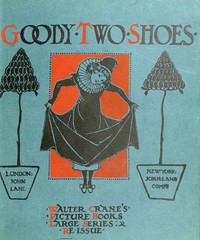
Crane's illustrations, reproduced in this Project Gutenberg edition from The Internet Archive, frame the text with ornamental borders and stylized figures. The narrative voice, formal yet brisk, shifts from grim exposition to sentimental relief when a clergyman and a visiting gentleman intervene. The pacing accelerates again as Margery, newly shod, runs to show the clergyman's wife, crying 'Two shoes, ma'am! See, Two shoes!'—a line that becomes her nickname and the story's pivot.
From Orphan to Teacher: The Narrative's Quick Turn
The opening paragraphs compress a full tragedy into a few sentences: the father dies of 'care and misfortune,' the mother follows, and the children are left 'in a sad plight.' But the story does not linger. Within a page, Mr. Goodall the clergyman offers shelter, and a gentleman from London orders Margery's shoes. The pace then slows to describe her delight and her determination to learn to read and write.
Margery becomes 'a better scholar than any of the children who went to the village school'—a claim that sets up her next role as a teacher of poor children. The narrative treats education as both a personal achievement and a social remedy, and it moves quickly from Margery's own learning to her teaching others. This compression of time and event is characteristic of the tale's efficient moral structure: hardship is swiftly followed by reward, and individual improvement leads directly to community benefit.
Voice and Repetition: The Power of a Catchphrase
The nickname 'Goody Two Shoes' originates in a moment of pure repetition: Margery 'kept on repeating' the words 'Two shoes, ma'am! See, Two shoes!' to everyone she met. The text emphasizes the oral, almost chant-like quality of her exclamation, and the name sticks because of its insistent rhythm. This verbal tic is the story's most memorable feature, and it signals a broader pattern of repetition in the narrative.
Phrases like 'honest, industrious countryman' and 'sad wandering sort of life' recur in formulaic patterns typical of moral tales. The narrator often addresses the reader directly, as when remarking that 'Heaven had heard their dying mother's prayers.' This voice is authoritative but not intimate, guiding interpretation without inviting debate. Crane's illustrations, with their decorative borders and stylized figures, reinforce the sense of a controlled, patterned world where every element—word, image, action—serves a clear purpose.
Pace and the Didactic Arc
The story's pace is uneven: it rushes through the parents' deaths and the children's rescue, then lingers on Margery's shoe-centered joy and her educational progress. This rhythm reflects the tale's didactic priorities. The early calamities are necessary setup, but the real interest lies in Margery's transformation from a barefoot orphan to a literate, industrious girl who teaches others.
Later episodes—such as Margery's encounters with animals and her involvement in a witchcraft trial—are mentioned in the catalog subjects but not fully developed in the excerpts. The narrative seems to maintain its brisk, episodic structure throughout, with each incident illustrating a moral point. Crane's illustrations, which appear at intervals, provide visual punctuation, slowing the reader's progress and emphasizing key moments. The overall effect is a story that moves quickly but pauses for instructive tableaux, balancing entertainment with explicit moral instruction.
This edition preserves the original text and Crane's illustrations, offering a glimpse into late-Victorian children's publishing. Readers may notice how the story's language and pacing differ from modern expectations: the rapid shifts from tragedy to cheerfulness, the reliance on repetition, and the direct moral commentary are all hallmarks of its era. Pay attention to how Crane's decorative borders frame the narrative—they are not mere ornament but part of the book's overall design, reinforcing the orderly, instructive world the text constructs.