1

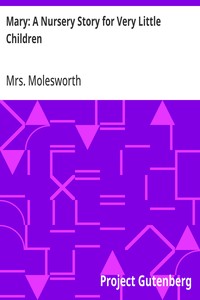
Mary: A Nursery Story for Very Little Children — Edition Insights
(0 User reviews)
787
Project Gutenberg
2013
Not confirmed
Christian life -- Juvenile fiction; Conduct of life -- Juvenile fiction; Children -- Conduct of life -- Juvenile fiction; Faith -- Juvenile fiction; Family -- Juvenile fiction; Birthdays -- Juvenile fiction; Sisters -- Juvenile fiction; Sick -- Juvenile fiction; Storytelling -- Juvenile fiction
Readers of public-domain and historical texts
Project Gutenberg digital edition
en
Edition facts
Words
40,770
Reading time
178 min
Text sections
5
Mary: A Nursery Story for Very Little Children — Edition Insights can be approached with a clearer sense of reading commitment from its source measurements: 40,770 words, 2 hr 58 min estimated reading time, and 5 detected text sections.
The text analysis averages about 16.6 words per sentence, while the detected sections provide another way to judge how the source is divided.
Project Gutenberg metadata also associates the work with “Christian life -- Juvenile fiction,” connecting these edition facts with the source record’s subject description.
Source:
Project Gutenberg record #43131
Mrs. Molesworth's 1878 nursery story follows four-year-old Mary through birthday wishes, baby sister worries, and everyday discoveries, with gentle humor and precise child psychology.
Read the complete public-domain text at its original source.
Read on Project GutenbergMary, not yet four, wakes early on a May morning and tries to puzzle out whether today is her birthday. The narrator stays close to Mary's limited understanding: she can read well but finds knitting harder, and she dislikes being told she'll understand when she's older. The opening establishes a voice that takes a child's logic seriously, even when it leads to mistakes—like Mary's worry that her birthday might have "changed out of May" because she cannot grasp how days and months work.
A Child's Reasoning on Display
The first chapter shows Mary working through problems with only her own resources. She knows that last year her birthday was Wednesday, and that next year it will be—she cannot remember. She tries to deduce whether months are easier than days: "In April there were showers, and in May flowers." The text does not correct her; it lets her think aloud. Later, when she worries that baby sister has no teeth and may never speak, nurse laughs and explains that teeth come gradually. Mary's relief is immediate, but the episode reveals how seriously she takes her responsibilities as an older sister.
Nursery Rhythms and Small Dramas
The story moves through ordinary days: a drive to town to choose a perambulator, a conversation about a blue sash, a moment when Mary cries because she cannot make baby understand her. The narrator notes that Mary "was not a very asking child" because big people did not always understand her questions. This detail recurs—Mary's internal life is full of unspoken confusions. The prose mirrors her pace, lingering on sensory details like sunshine making old nursery furniture look "shiny and sparkling, as if fairy fingers had been rubbing it up."
The Role of the Adult Witness
Mamma and nurse appear as patient observers. When Mary is upset about baby's teeth, nurse does not dismiss her fear but sits on the grass and laughs—then explains. Mamma, seeing Mary's red eyes, does not press but instead announces the drive to town, knowing that "the tears were rather ready to come back." These adults do not lecture; they redirect. The story trusts that young readers will recognize the kindness in such moments, just as Mary recognizes that nurse's laughter is not mockery but affection.
Language and the Very Young Reader
The vocabulary is simple but not condescending. Words like "perambulator" and "grounding" appear without explanation, letting context supply meaning. Mary's own speech is transcribed phonetically—"birfday," "p'raps," "'amember"—which signals her age without making her seem foolish. The narrator occasionally addresses the reader directly: "I never knew a baby that did not want a lot of things." This technique creates a shared, conspiratorial tone, as if the adult reading aloud and the child listening are both in on the joke.
Readers who attend to the small details—Mary's careful spelling of "May" and "Mary," her silent frustration with explanations she cannot follow—will find a portrait of early childhood that is both affectionate and unsentimental. The story rewards a slow reading, one that pauses to notice how the narrator balances a child's limited view with an adult's understanding.
There are moments in Mary—the quiet watching of a baby sister, the small ache of a wish deferred—that feel less like fiction and more like a memory of being four. I found that same tender honesty in Little Nettie; or, Home Sunshine — Reading Notes; it lingers on the gentlest of childhood struggles without ever hurrying past them. Perhaps old books simply remember us better than we remember ourselves.
There are no reviews for this eBook.
There are no comments for this eBook.
Reader reflection
How did this book work for you?
Your answers remain private and are stored only in this browser.
Your progress
0
/
10
2
How much did you enjoy the reading experience?
3
Would you recommend this book to another reader?
4
What was the reading difficulty like?
5
How useful did the reading feel?
6
How original did the book feel?
7
Did any part of the book feel personally relevant?
8
Is this a title worth rereading?
9
Which lesson or insight stayed with you?
10