1

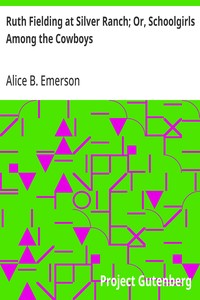
Ruth Fielding at Silver Ranch; Or, Schoolgirls Among the Cowboys — A Closer Reading
(0 User reviews)
1922
Project Gutenberg
2011
Not confirmed
Vacations -- Juvenile fiction; Montana -- Juvenile fiction; Ranch life -- Juvenile fiction; Fielding, Ruth (Fictitious character) -- Juvenile fiction; Boarding school students -- Juvenile fiction; Grassland fires -- Juvenile fiction
Readers of public-domain and historical texts
Project Gutenberg digital edition
en
Edition facts
Words
50,069
Reading time
218 min
Text sections
6
The catalog record for Ruth Fielding at Silver Ranch; Or, Schoolgirls Among the Cowboys — A Closer Reading provides practical reading context through 50,069 words, 3 hr 38 min estimated reading time, and 6 detected text sections.
The text analysis averages about 15.0 words per sentence, while the detected sections provide another way to judge how the source is divided.
Project Gutenberg metadata also associates the work with “Vacations -- Juvenile fiction,” connecting these edition facts with the source record’s subject description.
Source:
Project Gutenberg record #36398
Ruth and her schoolmates visit a Montana ranch, where they encounter cowboys, a bashful foreman, and a prairie fire. The narrative contrasts Eastern decorum with Western bluntness, and a schoolhouse dance becomes a stage for social maneuvering.
Read the complete public-domain text at its original source.
Read on Project GutenbergThe story opens at a place called “The Crossing,” a ramshackle store and schoolhouse where two cowboys sit cross-legged on the porch, eating canned peaches with their knives. This image—casual, self-sufficient, and faintly absurd—sets the tone for a book that juxtaposes the polished manners of Briarwood Hall girls with the rough hospitality of Silver Ranch. The cowboys’ drawled speech (“Gittin’ to Bullhide this mawnin’”) and the storekeeper’s proprietary armchair establish a world where social hierarchies are both fluid and sharply observed.
Bashful Ike and the Dance Floor
The character of Ike Stedman, the ranch foreman nicknamed “Bashful Ike,” is a focal point for the book’s interest in social performance. In the excerpt from Chapter XIV, Ruth orchestrates a plan to boost Ike’s confidence at a schoolhouse dance. She enlists Jane Ann, the ranchman’s niece, and the other girls to dance with him, hoping to make Sally Dickson—the schoolteacher who has been dismissive of Ike—see his worth. The dialogue is revealing: Ruth calls Ike “as kind-hearted a man as I ever saw,” while Jane Ann admits he’s “a right good feller” but worries about his clumsiness. When Jane Ann drags Ike onto the floor, he protests, “Just as like as not, honey, I’ll trample all over you an’ mash yo’ feet.” Yet once dancing, he proves competent. The scene hinges on a tension between perceived awkwardness and actual ability, and on the girls’ deliberate manipulation of social optics—a pattern that recurs throughout the book.
Eastern Girls, Western Codes
The book’s subtitle, Schoolgirls Among the Cowboys, signals a central contrast: the decorum of a boarding-school girl versus the bluntness of ranch life. Ruth’s whispered planning with Jane Ann shows her applying the social strategies of Briarwood Hall to a Montana dance floor. She speaks of making Ike “forget his clumsiness” and of “awakening Miss Dickson to poor Ike’s good points”—language that could come from a schoolroom intrigue. Yet the setting forces adjustments: Jane Ann’s exclamation “Oh, crickey!” and her teasing about Sally’s jealousy belong to a different register than Ruth’s measured tones. The cowboys, too, have their own codes. When Tom Cameron “broke the ice” by asking the schoolteacher to dance, and Bob followed suit “(Mary engineered that),” the parentheses hint at a backstage maneuvering that the narrative treats as both familiar and amusing. The friction between Eastern refinement and Western directness is not resolved but played for comedy and mild suspense.
Fire, Stampede, and the Threat of Disorder
The catalog subjects list “Grassland fires” and “Ranch life,” and the chapter titles promise a stampede, a desperate case, and a plucky fight. The opening chapter, “Old Trouble-Maker,” introduces a figure (possibly a horse or a person) that disrupts routine. The excerpts do not reveal the full plot, but the pattern is clear: the orderly world of the schoolgirls—their dances, their plans, their social hierarchies—is repeatedly interrupted by the physical dangers of the West. The fire fight (Chapter IV) and the stampede (Chapter XVII) are not merely action set-pieces; they test the girls’ resourcefulness and force them to act outside their usual roles. Ruth’s “mettle” is mentioned in a chapter title, and the closing chapters suggest a return to the “Old Red Mill,” framing the ranch as a temporary, transformative space. The book thus balances two kinds of tension: the social tensions of the dance floor and the elemental tensions of fire and herd.
Readers should pay attention to the way the narrative shifts between interior motives and external action. Ruth’s quiet orchestration of the dance is as important as any fire-fighting scene. The book rewards attention to dialogue—the cowboys’ drawl, the girls’ exclamations—and to the small details of setting, like the store porch or the schoolhouse, that anchor the story in a specific place. The incomplete excerpts leave the full arc of Ike and Sally’s relationship unclear, but the dance episode offers a satisfying microcosm of the book’s concerns: performance, perception, and the effort to make a community cohere.
That rainy afternoon, Ruth Fielding at Silver Ranch left me lingering on the schoolhouse dance—how the bashful foreman’s raw honesty cut through the girls’ careful social steps. Western plainness against Eastern decorum. The feeling stayed with me, restless, until my hand drifted to another shelf and pulled down Little Nettie; or, Home Sunshine — Reading Notes, where a child’s quiet warmth offered a gentler kind of unfiltered truth. They sat together oddly well.
There are no reviews for this eBook.
There are no comments for this eBook.
Reader reflection
What did you think of this book?
Answer a few questions and save a private reflection on this device.
Your progress
0
/
10
2
How did the book work for you overall?
3
How likely are you to recommend this book?
4
How easy was the book to follow?
5
Would this book work well in a reading group?
6
Do you expect to return to this book?
7
Which element worked best for you?
8
Did the story or argument move comfortably?
9
What is the main idea you are taking away?
10