1

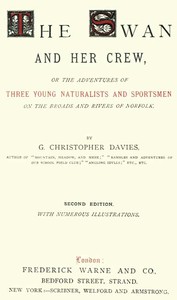
The Swan and Her Crew or The Adventures of Three Young Naturalists and Sportsmen on the Broads and Rivers of Norfolk — Background and Themes
(0 User reviews)
1578
Project Gutenberg
2012
Not confirmed
Animals -- Juvenile fiction; Conduct of life -- Juvenile fiction; Children -- Conduct of life -- Juvenile fiction; Fishing -- Juvenile fiction; Flowers -- Juvenile fiction; Birds -- Juvenile fiction; Yachts -- Juvenile fiction; Natural history -- Juvenile fiction; Outdoor life -- Juvenile fiction; Butterflies -- Juvenile fiction
Readers of public-domain and historical texts
Project Gutenberg digital edition
en
Edition facts
Words
86,179
Reading time
375 min
Text sections
12
The Swan and Her Crew or The Adventures of Three Young Naturalists and Sportsmen on the Broads and Rivers of Norfolk — Background and Themes can be approached with a clearer sense of reading commitment from its source measurements: 86,179 words, 6 hr 15 min estimated reading time, and 12 detected text sections.
The text analysis averages about 20.0 words per sentence, while the detected sections provide another way to judge how the source is divided.
Project Gutenberg metadata also associates the work with “Animals -- Juvenile fiction,” connecting these edition facts with the source record’s subject description.
Source:
Project Gutenberg record #40214
This editorial note examines how the catalog subjects of natural history and conduct of life align with the actual text of Davies's 1880s boys' adventure, focusing on the tension between instructional content and narrative action in the Norfolk Broads setting.
Read the complete public-domain text at its original source.
Read on Project GutenbergThe catalog subjects for The Swan and Her Crew list eleven topics, from “Animals” and “Birds” to “Conduct of life” and “Children—Conduct of life.” The excerpts, however, show a book far more interested in the mechanics of natural history—how to stuff a crossbill, dig for pupae, or bob for eels—than in explicit moralizing. The preface itself frames the work as a response to reader questions, offering further information by mail. This note traces how the catalog’s broad categories map onto the actual texture of the prose, where a chapter on “A Momentous Decision” may be as much about choosing a yacht as about character.
Natural History as Procedure
The catalog lists “Natural history” as a subject, but the excerpts reveal a specific emphasis on hands-on technique. In chapter 2, the boys are “stuffing the Crossbills”; in chapter 4, they are “Digging for Pupæ.” The narrative pauses to describe the metamorphosis of a butterfly in detail, and later a character delivers “A Botanical Lecture.” The instructional tone is reinforced by the author’s offer in the preface to answer readers’ letters. Yet the catalog’s “Animals” and “Birds” headings are too broad: the text focuses on collecting, preserving, and identifying specimens, not on general animal behavior. The “Butterflies” subject is accurate, but the excerpts show it is treated as one item in a longer list of natural-history pursuits, not a central theme.
Conduct of Life in Action
The catalog includes “Conduct of life” and “Children—Conduct of life,” but the excerpts rarely state moral lessons outright. Instead, conduct is implied through the boys’ resourcefulness and cooperation. When Frank asks the woman for worsted to bob for eels, he offers to pay double—a small gesture of fairness. Later, the boys reject the idea of abandoning their yacht and walking home as “infra dig.,” preferring to sail back “in a legitimate way.” The phrase “otium cum dignitate” (ease with dignity) appears as a joke, but it signals the value placed on self-reliance. The catalog’s moral categories fit, but the text embeds them in practical problem-solving rather than sermonizing.
Setting as Character
The catalog lists “Yachts” and “Fishing” as subjects, but the excerpts show the Norfolk Broads functioning as more than a backdrop. The prose lingers on specific landscapes: “waving reed-beds,” “acres … white with the silky globes of the cotton-grasses,” “whirling wind-mills.” The yacht The Swan is a tool for accessing this environment, not the focus. The catalog’s “Outdoor life” subject is accurate, but the excerpts reveal a deep local knowledge—of tides, winds, and bird behavior—that goes beyond generic outdoor adventure. The setting is not just a place for action but a subject of study in its own right, aligning with the natural-history emphasis.
Readers approaching The Swan and Her Crew through its catalog subjects should expect a hybrid work: part field manual, part travelogue, part boys’ adventure. The moral instruction is present but understated, carried by the boys’ actions rather than authorial commentary. The natural history is procedural and specific, not general. The setting is the book’s strongest character. These observations are drawn from the excerpts alone; the full text may shift emphasis, but the catalog’s broad categories are a useful starting point, not a complete description.
Reading through the old notes on The Swan and Her Crew, I kept thinking about how its gentle lessons about patience and observing nature echo in a quieter way through the pages of Ruth Fielding in the Red Cross; Or, Doing Her Best for Uncle Sam — Reading Notes. Both feel like quiet company on a long afternoon, each holding a calm sense of duty between the lines.
There are no reviews for this eBook.
There are no comments for this eBook.
Reader reflection
What did you think of this book?
Answer a few questions and save a private reflection on this device.
Your progress
0
/
10
2
How did the book work for you overall?
3
Would you encourage someone else to read it?
4
How much effort did this book require?
5
Did the book give you something worth debating?
6
Is this a title worth rereading?
7
How clearly were the main ideas presented?
8
Was the book moving at the right speed?
9
What did this book teach you most?
10