1

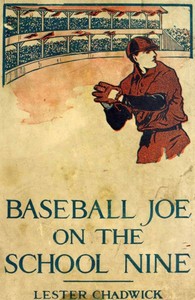
Baseball Joe on the School Nine; or, Pitching for the Blue Banner — A Closer Reading
(0 User reviews)
620
Project Gutenberg
2012
Not confirmed
Conduct of life -- Juvenile fiction; Young men -- Conduct of life -- Juvenile fiction; Students -- Juvenile fiction; Diligence -- Juvenile fiction; Success -- Juvenile fiction; Baseball stories; Envy -- Juvenile fiction; Baseball players -- Juvenile fiction
Readers of public-domain and historical texts
Project Gutenberg digital edition
en
Edition facts
Words
55,377
Reading time
241 min
Text sections
7
The source record for Baseball Joe on the School Nine; or, Pitching for the Blue Banner — A Closer Reading measures this digital text at 55,377 words, 4 hr 1 min estimated reading time, and 7 detected text sections.
The text analysis averages about 13.6 words per sentence, while the detected sections provide another way to judge how the source is divided.
Project Gutenberg metadata also associates the work with “Conduct of life -- Juvenile fiction,” connecting these edition facts with the source record’s subject description.
Source:
Project Gutenberg record #38897
This editorial note examines Lester Chadwick's diction, dialogue, and descriptive choices in a 1912 boys' baseball novel, focusing on how nicknames, confrontational speech, and physical details shape the school story.
Read the complete public-domain text at its original source.
Read on Project GutenbergLester Chadwick opens Baseball Joe on the School Nine with a snowball fight, immediately establishing a world where nicknames like “Peaches” and “Teeter” define characters through physical traits or habits. The dialogue is brisk and colloquial, with exclamations such as “Aw come off” and “You get off the earth” setting a casual, competitive tone. Chadwick uses these early exchanges to introduce conflict not through plot summary but through the boys’ own voices, as when Teeter declares, “Let Joe Matson have a try.”
The author’s descriptive choices are equally telling. The phrase “the horsehide went speeding toward the plate” in the frontispiece caption emphasizes the materiality of the baseball, while the repeated use of “bully” and “sneer” in chapter titles signals a moral framework where authority is contested through direct speech and physical posturing.
Nicknames as Characterization
Chadwick relies heavily on nicknames to convey personality and social standing. “Peaches” (Dick Lantfeld) is named for his fair complexion, “Teeter” (Harry Nelson) for a nervous habit. These monikers are used consistently in dialogue and narration, reducing the need for explicit character description. The nickname “Hiram” for the antagonist is never explained, but his title “the bully” is reinforced through others’ speech: “the bully sneered” and “the bully turned a bit pale.” This technique aligns with the series’ formula, where names often signal a character’s role—Joe Matson is simply “Baseball Joe,” his identity fused with the sport.
The nicknames also create a hierarchy. Teeter’s authority in the meeting scene is underscored by his being called “the self-constituted chairman,” while Hiram’s supporters remain nameless as “his supporting army.” Chadwick uses this shorthand to manage a large cast without slowing the narrative.
Confrontational Dialogue and Power Shifts
The meeting in Chapter XVII is a set piece of verbal sparring. Chadwick writes dialogue that escalates through interruptions and challenges: “Well, what’s it all about?” demands Hiram, to which Teeter retorts, “We want the ball team managed differently.” The exchange is punctuated by collective shouts—“That’s right!” and “We’re with him”—showing how group dynamics shift power. The author uses stage directions like “the now fully aroused Teeter” and “Hiram turned a bit pale” to externalize internal states.
Chadwick avoids long speeches; instead, characters interrupt and overlap. When Hiram tries to dismiss the revolt as “for the benefit of Joe Matson,” Joe quickly denies it, and Teeter counters with “That’s the trouble—he isn’t.” This rapid-fire dialogue mirrors the pace of a baseball game, where every pitch and response matters.
Physical Description and Gesture
Chadwick often conveys emotion through physical details rather than introspection. In the meeting, Teeter’s “gavel clenched in his hand” and the way Joe, Tom, and Peaches “crowded up around Teeter, like a bodyguard” create a visual tableau of solidarity. Hiram’s pause is attributed to “the fearless manner in which he faced Hiram” and the gavel itself—a concrete object that substitutes for authority.
Similarly, the snowball fight in Chapter I uses action to reveal character: Peaches boasts he can throw high, but the group turns to Joe, implying his skill. The author’s descriptions are functional—snowballs, a gavel, a baseball—and rarely decorative. This spare style keeps the focus on the boys’ physical presence and their struggles for dominance.
Repetition of Key Phrases and Motifs
Chadwick repeats certain phrases to reinforce themes. The word “bully” appears in chapter titles and narration, while “sneer” is a recurring verb for Hiram. In the meeting, Teeter’s demand for “a change” is echoed by the crowd. The phrase “the whole school” is used twice in close succession, emphasizing that the conflict extends beyond the team.
The baseball itself is a motif: the frontispiece shows “the horsehide went speeding,” and later “the white ball was plainly visible.” These descriptions are sensory but not lyrical; they ground the story in the physical game. Chadwick also uses the word “crisis” to label the meeting’s outcome, a term that signals the stakes without melodrama.
Readers attentive to Chadwick’s authorial choices will notice how he builds tension through dialogue and gesture rather than interior monologue. The nicknames, the repeated physical cues, and the rapid exchanges all serve to keep the story moving at a pace suited to its young audience. This edition invites attention to the craft behind a formulaic series, where every word is chosen to advance action and character in equal measure.
Sitting with Chadwick’s baseball boys, I was struck by how their world feels so contained—every nicknamed rivalry and tense inning bounded by the school yard. It made me think of another, quieter kind of comradeship, likewise rooted in a single season and landscape, where three lads learn patience from herons and reeds. The Swan and Her Crew or The Adventures of Three Young Naturalists and Sportsmen on the Broads and Rivers of Norfolk — Background and Themes holds that same lingering warmth, if a gentler game.
There are no reviews for this eBook.
There are no comments for this eBook.
Reader reflection
Your personal reading reflection
Build a private reading journal entry for this title.
Your progress
0
/
10
2
How did the book work for you overall?
3
Would you pass this book on to a friend?
4
What was the reading difficulty like?
5
How useful did the reading feel?
6
Did any part of the book stay with you emotionally?
7
Did you relate to its people, ideas, or situations?
8
How distinctive were its ideas or approach?
9
What changed or sharpened your thinking?
10